Services
Four ways engagements start.
Every one of them begins with a discovery conversation, because scoping work before we understand the obstacle is guesswork. We will ask what you are trying to achieve and what is getting in the way, then propose something shaped to the answer.
Book a discovery conversation01
Organizational transformation
Cultural transformations commonly plateau after a few years, or fail outright as the latest flavour of the month. We work with leadership teams to build the operating system underneath the change, then hand it over.
In practice that means a daily management system people actually use, coaching routines that run without us, and internal coaches developed far enough that the capability stays in the building. We start in one area where leadership is engaged, prove the pattern there, and scale from a working example rather than a slide deck.
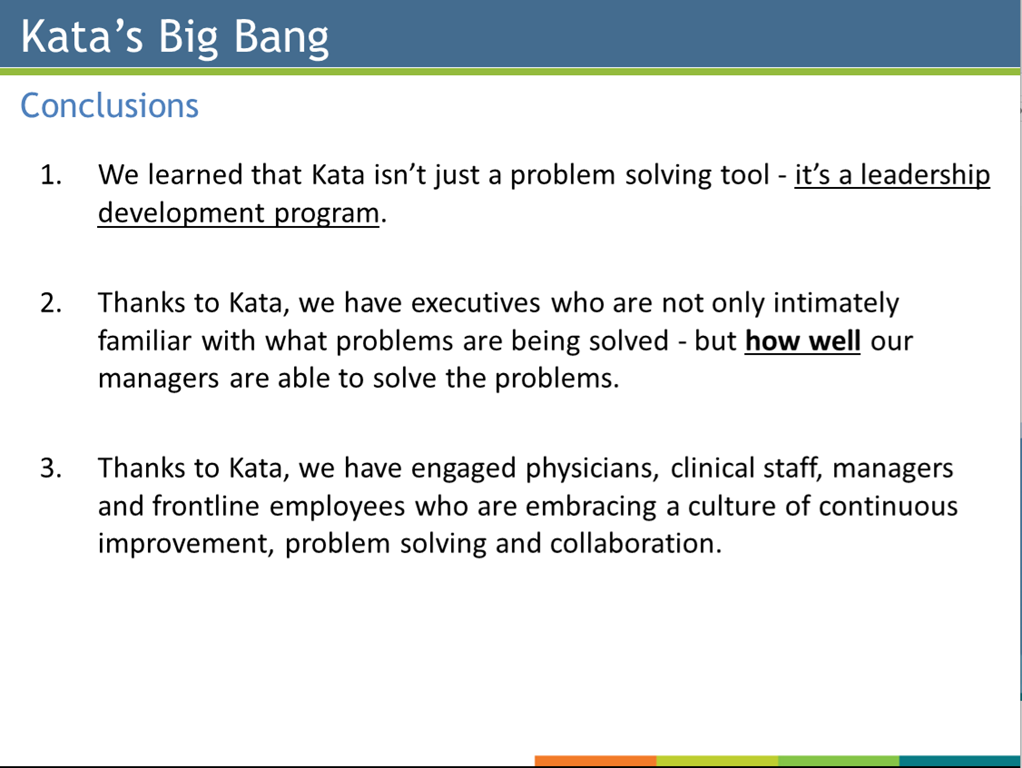
This is the work that has to outlast us. At one 3,000 employee regional health system the daily management system held through a change of executive team, which is the only test of a transformation that really counts.
02
Process and product redesign, 3P
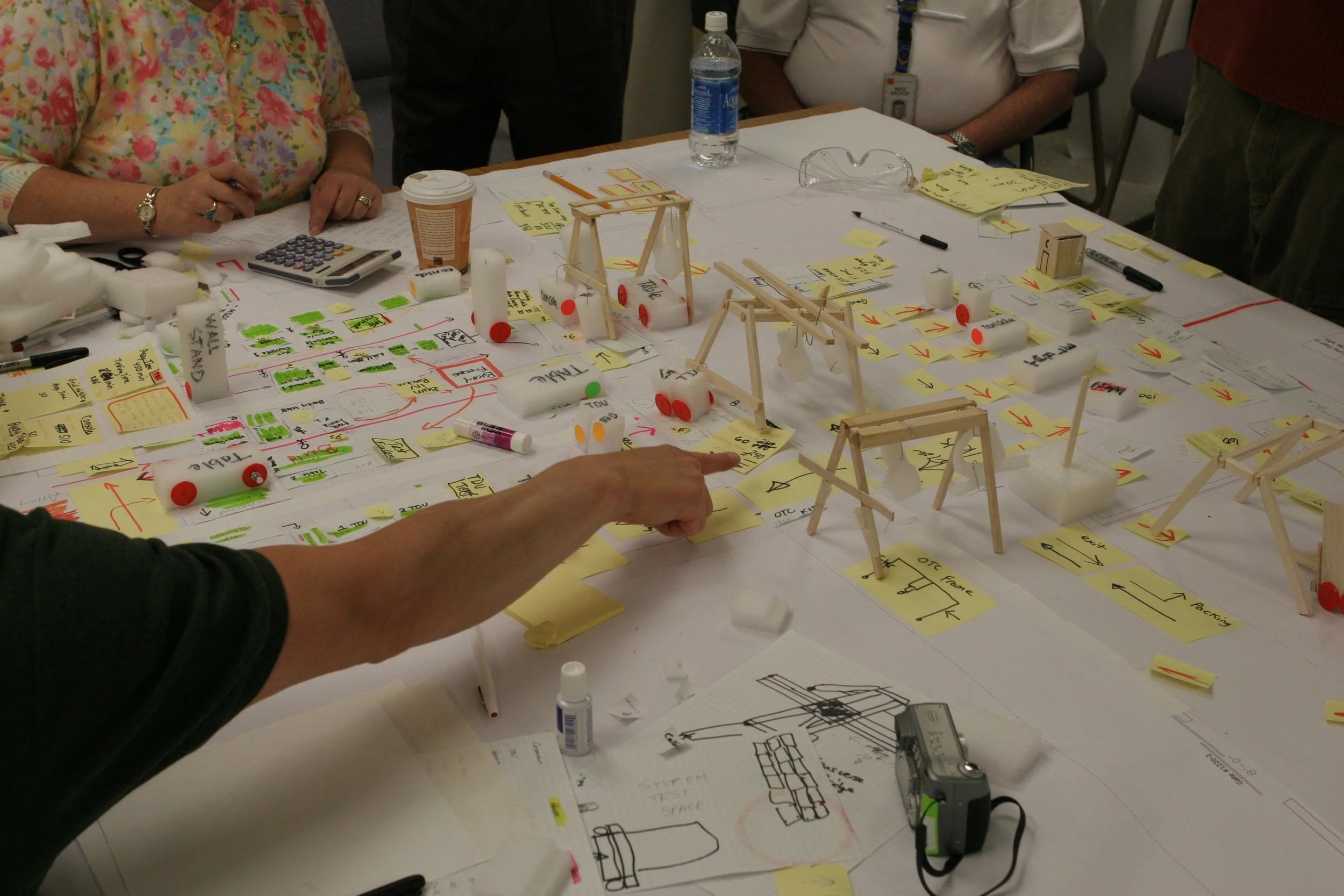
Everything on this table was built that morning by the people who do the work.
3P stands for Production Preparation Process. It is a way of designing a product, a workflow, or a building with the people who will run it, using rough full-scale mock-ups, before anything is bought or poured.
The method is deliberately simple and runs in three passes:
- Map perfect flow for one. The ideal journey for a single unit, or a single patient, with no compromises yet.
- Add volume. Scale that flow to a genuinely heavy day, not an average one. Designing for the average means being overwhelmed half the time, and it is far easier to take capacity out than to add it.
- Add constraints and barriers. Introduce the real obstacles, and solve them while changing the design is still free.
A counter-intuitive rule earns its keep here: design around the most complex case, not the most common one. Harmonize the flow for the hardest journey and the simpler ones fall out of it by skipping steps. Design around the most common one and every exception breaks the system.
We have run this on products from analytical instruments to industrial scissor lifts, and on workflows from factory cells to emergency departments, cancer centers, and outpatient clinics.
03
Leadership development and coaching
Leadership is hard, and it should never be a solo journey.
We partner with business owners and senior leaders who want a collaborative working partner for the next stretch, rather than a report telling them what to do. The aim is always to develop your own coaches, so the capability does not leave when we do. One of the first people we trained this way, a veteran medical practice manager, said after coaching a peer: I feel like I have a purpose again, I am a teacher.
If you are a small business owner and cost is a concern, ask us about pairing with other owners to split the cost and gain a second working partner in the bargain.
04
Keynotes, workshops, and learning tours
Workshops are highly interactive and frame the next step for the people in the room, rather than the whole journey.
You can elect on-site follow up where a workshop is the front end of a transformation. We also facilitate executive retreats and lead tours of genuine learning organizations, with the goal of understanding the principles underneath the tools rather than collecting more tools.
Craig has presented at the Kata Summit in 2018, 2019 and 2020, where the leadership training preview was the first session to sell out, and at the 2024 TWI Summit on the fundamentals of deliberate practice.
A shared way of solving problems, a half day session for a whole company and its managers
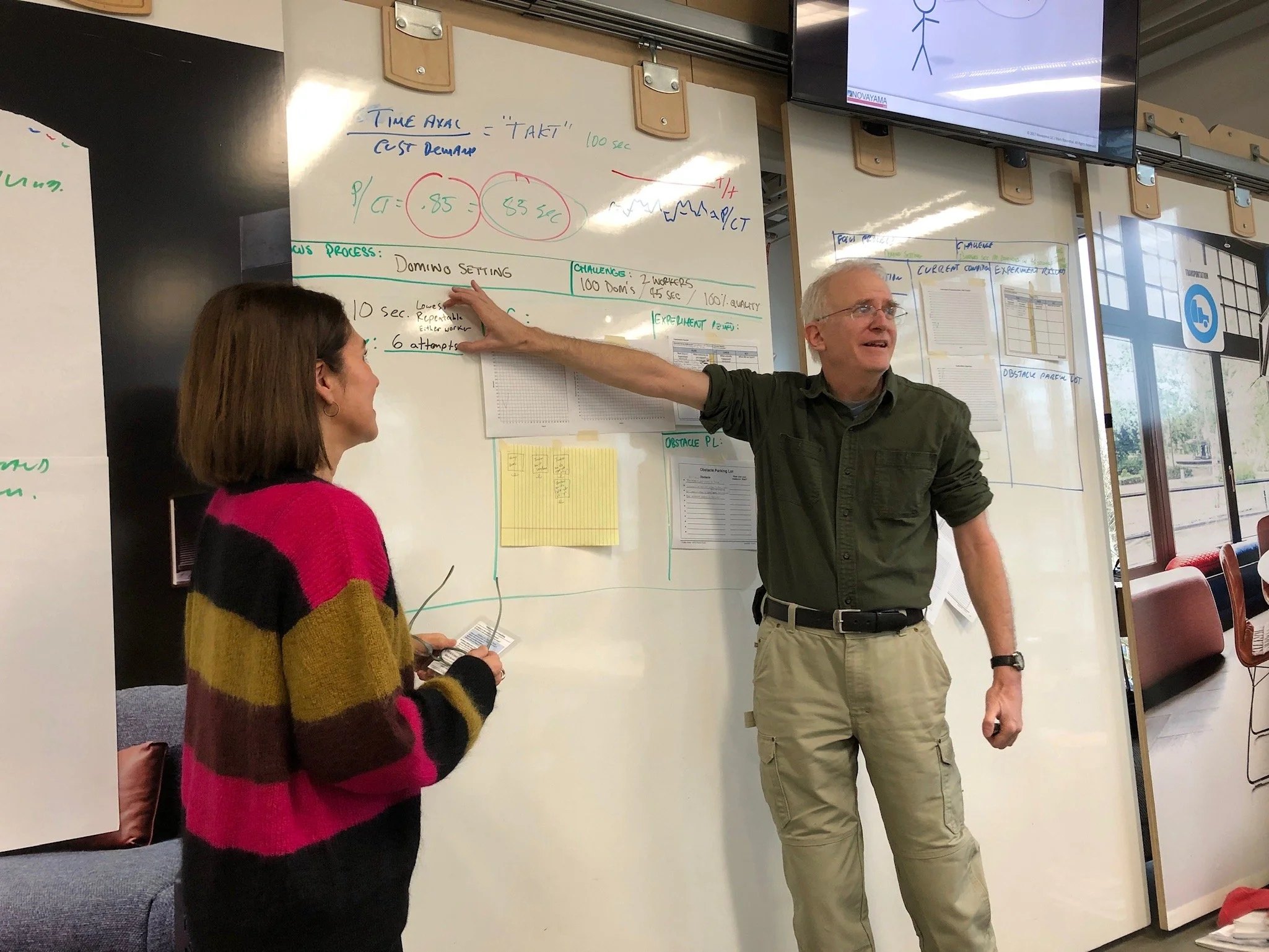
A workshop exercise. People learn rhythm and cycle time considerably faster by running one than by being shown a definition.
A note on company stage
Scaling without the chaos.
Companies still scaling are not a separate sector, they are a stage, and the advice is about the stage rather than the industry. In a fast-moving company it is easy for teams to be overwhelmed by pivots, new hires, and investor demands at the same time.
The work there is a structured but flexible frame: daily problem-solving habits and transparent feedback loops that prevent permanent firefighting, cross-functional teams that cut rework out of product development, and leadership structures and team norms designed to survive growth, so the culture that attracted the first ten people still exists at a hundred.
How we scope
What to expect from a proposal.
- It starts from your stated goal and the obstacles in the way, not from a menu.
- It gives a timeline range rather than a fixed end date, because the rate of learning is the variable that matters and it is not knowable on day one.
- It is itemized by workstream or phase rather than presented as a single lump sum.
- It states plainly what is not included, and how additional scope is handled.
- It names which partner leads which workstream.
Curious how this would work on your team?
Book a discovery conversation. We will ask what you are trying to achieve and what is getting in the way, which is also how every engagement starts. Practical conversation, no sales pitch.