Our approach
Why transformations stall, and what holds.
Most organizational transformations fail. They do not have to. Success is not mainly about efficiency or tools. It is about understanding how individuals and groups actually change habits, and building for both sides at once.
Start with a simple system that works.
A complex system that works is invariably found to have evolved from a simple system that worked. The inverse proposition also appears to be true: a complex system designed from scratch never works and cannot be made to work. You have to start over, beginning with a working simple system. Gall's Law
The technical change an organization implements is usually over-complicated, and the instinct when it underperforms is to double down on the complication. We do the opposite. We start with a simple system that fits your organization, use it to gently surface the issues people are already living with, learn how your organization wants to support the person hitting each issue, and only then scale.
Where to begin: not where you have the biggest problems, but where you have the most engaged leadership. The biggest problem is the intuitive place to start and usually the worst one, because it is where the least slack, the most scrutiny, and the least patience are. Engaged leadership is what makes the first cycle survive long enough to teach anybody anything.
The key is the rate of learning, not the size of the first win.
The technical half
What technical skills do leaders need?
The great benefit that science provides is the ability to share the results once obtained from one person to another. In contrast, this is impossible with empirical methods, which rely on interpretation of personal experience, while science can be taught. Henry Le Chatelier
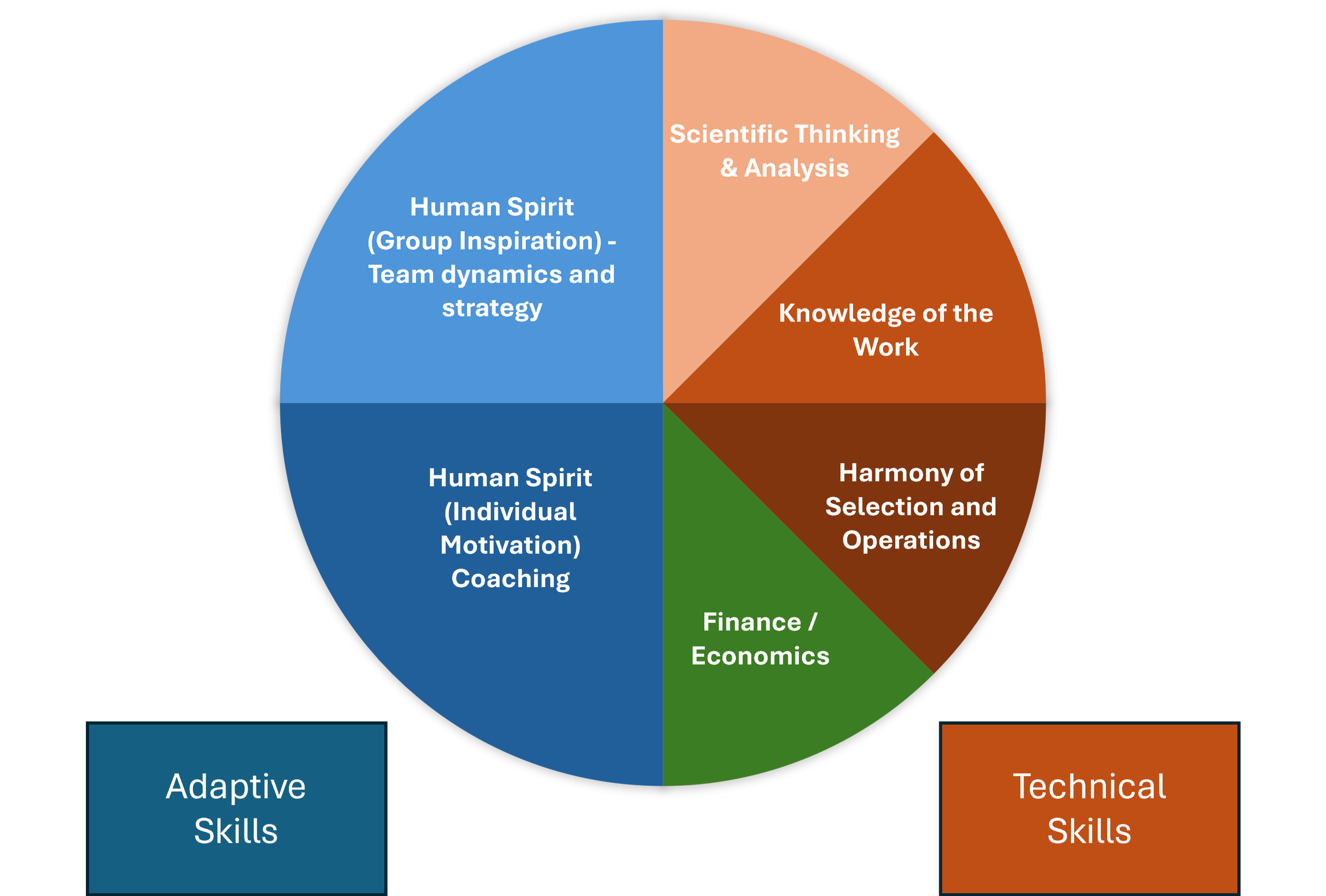
Real technical excellence is about more than the best machines or the newest technology. It starts with observation, experimentation, and teaching everyone to see, solve, and improve together.
1. Scientific thinking and analysis
Asking good questions, testing ideas, and learning from the result. Leaders need to be able to convert ignorance into knowledge and then use the best known approach, which usually means a working foundation in statistics and critical thinking.
2. Knowledge of the work
Supervisors are often promoted for technical know-how, which is valuable and also the least important skill in effective leadership. Whatever their background, leaders support the people they depend on by learning how the process truly works from the people doing it, breaking jobs down into teachable parts, and making feedback an everyday habit rather than an event.
3. Flow and rhythm
Designing and synchronizing the flow of material and information: right-sized equipment and work cells, and departments coordinated so activity follows a clear beat. This is the oldest idea in the field and the one most often skipped.
4. Finance and economics of the work
Often overlooked, because that is what the finance department is for. Leaders need to understand cost flows and true value streams. Before launching a line or a service: what is the expected demand, and are the equipment, teams, and space sized to deliver real value? Focusing only on cost reduction ironically drives cost up.
We build good ships. At a profit if we can, at a loss if we must. But always good ships. Newport News Shipbuilding
Every operation has an optimal run rate, ideal not only for efficiency but for people, the way a marathon runner has an ideal pace. In booms and slowdowns alike, leaders have to be able to adjust the system to regulate capacity, cost, and value.
The adaptive half
What adaptive skills do leaders need?
People do not fear change, they fear loss. Nobody throws away the winning lottery ticket. Ron Heifetz
Many popular change models share an assumption: that resistance is best handled by sorting people into categories and, if necessary, removing those who do not get on board quickly. Our experience, and the research, shows something more useful.
How one person changes a habit
The best coaches meet people where they are, set achievable short-term goals, and celebrate progress rather than perfection. That keeps people engaged and turns them into coaches in turn. We draw on proven methods from sport, from industry, from the classroom, and on current research into intrinsic motivation.
Just as leaders learn to find the constraint in a flow of material, they have to find the current constraint on a person's learning and growth. It is the leadership parallel to Liebig's law: a system, or a person, grows only as much as the least met need allows. Real change depends on removing the obstacle to competence, autonomy, or support. Anyone who has watched a motivated, skilled person get worn down by a total absence of support knows what an unmet need costs.
A leader's job is both to challenge and to nurture.
How a group changes habits
Group change follows natural patterns. Resistance falls when leaders move gradually and let people adjust at their own pace, rather than forcing a sudden sweeping change. It is the difference between walking into a pool and doing a belly flop.
The law of inertia of habits matters to organizational change the way physical inertia matters to Newtonian motion. As Adamiecki put it, it is better to know this law accurately, adapt to it, and make proper use of it, since complaining will not help, just as complaining about gravity will not, and gravity when properly understood brings great benefit instead of misfortune.
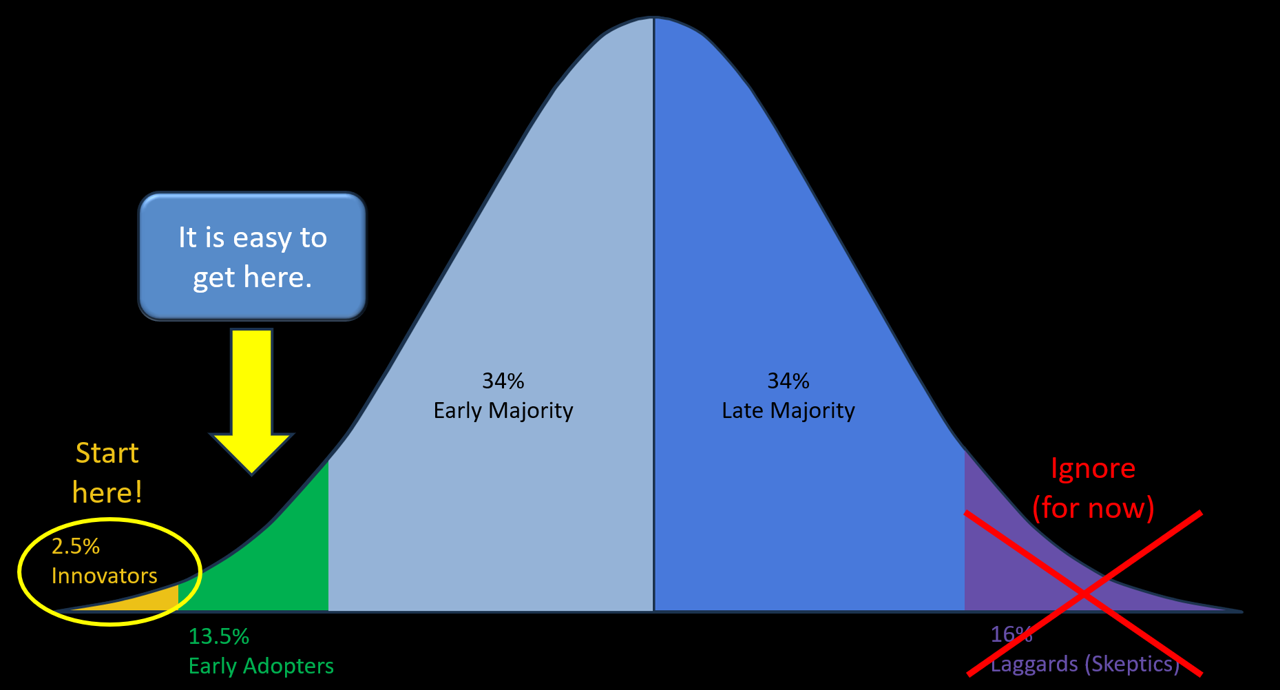
Change also spreads by diffusion. Some people are eager, some are cautious, and many want more evidence first. Those thoughtful skeptics are valuable and help organizations avoid expensive mistakes. The fastest and healthiest transformations support the early adopters, who then demonstrate the result and carry the rest.
Putting them together
Neither half works alone.
Lean tools and agile practices work. Without leadership for the human side, success stalls. Invest in both and transformation stops being a matter of luck and becomes a reasonably expected outcome of knowledge and skill, which is exactly what it was for the organizations that did this well a century ago.
The tools of successful organizations are remarkably similar and fairly easy to copy. There is little disagreement that they work. The difficulty lies in the human foibles presented along the way.
When technical excellence and adaptive leadership develop together, transformation becomes not only possible but hard to avoid.
A caution worth stating
We are not a fit for every organization.
We work by developing people through solving real problems, which takes leadership attention and takes it repeatedly. An organization looking to buy a result without changing how its leaders spend their time will be disappointed, and would be better served by someone else.
If what you want is a team that looks forward to tomorrow's problems because they are getting measurably better at solving them, that is the work.
Curious how this would work on your team?
Book a discovery conversation. We will ask what you are trying to achieve and what is getting in the way, which is also how every engagement starts. Practical conversation, no sales pitch.