Industries / Healthcare
Improving at the speed of thought.
The difference between good healthcare organizations and great ones is the ability to build the capability of people to improve the flow of material, information, and cost. Not to buy that capability, and not to merge with it.
Documented, Meritus Health
- 95% under 20 minutes Door to treatment in the Emergency Department after the patient flow redesign. Meritus Health
- Waiting room virtually gone Along with a near elimination of patients leaving without being seen. Meritus Health
- 25% fewer psychological admissions A consequence of addressing care delays and supporting earlier medication intervention. Meritus Health
Sources: the transformation was presented at the national Kata Summit and featured by the Lean Enterprise Institute and in AME Target Magazine, October 2017, page 20.
The engagement
Reviving a transformation that had stalled.
Meritus Health is a 3,000 employee regional health system in Hagerstown, Maryland. It had been doing lean for five years, largely through five-day events and A3 projects, and had hit the plateau that almost every serious improvement program hits.
Craig joined as Operations Improvement Director in 2015, reporting first to the VP of Quality and later directly to the CEO through an executive transition.
The first attempt started at the department level, aiming at the organizational challenge of getting patients home on time. It turned into something more useful almost immediately. The nurses could not get home on time either. They could not reliably take an uninterrupted lunch.
So the goal changed to lunch on time. Proactively understanding and removing the burdens on the staff first rebuilt trust that had been lost, and it did something the original goal could not have done: it made the improvement system credible to the people who had to run it. That unit set the pattern for the rest of the organization.
Invite, do not assign.
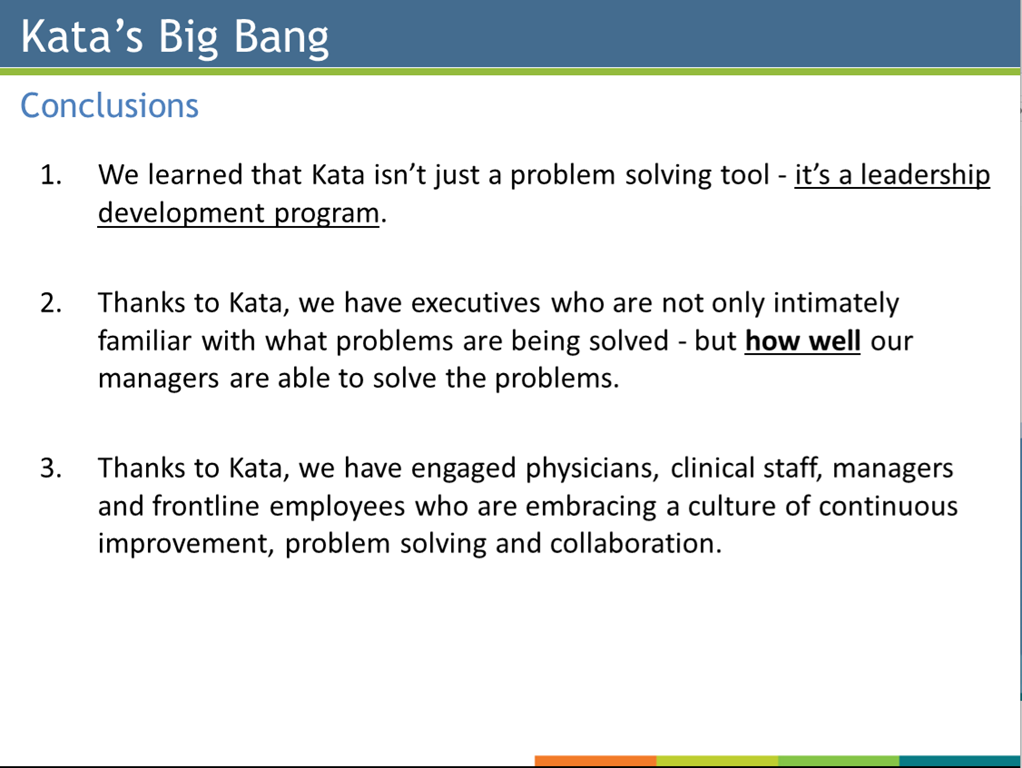
Within the senior leadership team we identified an advance group of volunteers who wanted to move from a culture of present and decide to one of experiment, collaborate, and learn. Inviting rather than assigning had an effect nobody planned for: other senior leaders felt left out and asked to join.
That is the diffusion principle doing its job. Start with the people who are already leaning forward, let them produce a result, and the rest follow on evidence instead of instruction.
The two halves eventually met in the middle. Daily problem solving at the unit level joined to senior leader rounding, forming a structured feedback loop that kept the organization aware and aligned. The system held through subsequent executive turnover, which is the only real test.
One early lesson is worth stating plainly, because it cost us months: we taught that new habits require frequent practice with a coach, while our own most experienced coaches stayed in their established routines. Nothing changed until that did.
The Emergency Department
Redesigning patient flow with 3P.
Beginning in spring 2016, the ED team combined 3P design with daily improvement cycles. A benchmarking visit to Lehigh Valley Health Network's direct bedding model shaped the approach, and Lehigh Valley later used what came out of the Meritus work to improve their own.
The first story is the best story
By the time a patient finally sees a physician, they are often telling their story for the fourth time, and the first telling was the most detailed. The design directs patients to a bed or a chair so that the first time they tell it, they are telling the treatment provider.
Keep vertical patients vertical
Why put every patient in a bed when many do not need one and are more comfortable in a chair? If they are ambulatory, keep them ambulatory. Beds are used when a bed is what the patient needs, which also solves the room turnaround problem that beds create.
Design for the hardest case
The team started by mapping the most common patient type, then changed approach. Every patient is unique but the diagnostic tasks are not. Designing around a chest pain or shortness of breath presentation, which needs the full set of resources, meant simpler journeys could be tested by skipping steps. A long bone fracture follows the same sequence without the EKG.
Model a heavy day, not an average one
Capacity was modelled on a day in the top 20 percent of the year for volume. Designing around an average day guarantees being overburdened half the time, and it is much easier to take capacity out than to add it. That calculation sized the Rapid Assessment Zone.
Implementation ran as tabletop simulation, then a process-at-a-glance, then live pilots. On pilot days obstacles were logged on flip chart pages as they appeared and crossed off as rapid experiments resolved them. The first pilot ran until mid-afternoon with full leadership present, then a second pilot, then a full shift, then the same sequence again for nights.
The most valuable thing the new process gave the team was not a number. It was visibility: for the first time the ED could see volume building through the day and what it would take to stay ahead of it. Bringing a second provider in at 11am, we could now see, already put the department in a deficit by the time they arrived.
Also at Meritus
Three more pieces of the same system.
Real time problem reporting
In collaboration with MIT professor Steven Spear, Meritus became the first healthcare organization to pilot a real time issue reporting system, adapting the idea of stopping the line for a hospital setting. Front line staff could raise a problem from a phone in one touch and flag whether it needed immediate help.
The interesting result was not the tool. Paired with an organizational dashboard, it forced real time conversations between departments that had been pointing fingers at each other, because now everyone was looking at the same data about the same root cause.
A problem nobody was looking for
Piloting the same system with Facilities Engineering surfaced something no one had asked about: the engineers sat physically far from where most issues occurred, and response times reflected it. Moving where the team sat cut average response time by roughly 75 percent.
That is a good illustration of the method. Nobody set out to solve it. The system made it visible and the fix was almost free.
3P beyond the ED
The same design method built a cancer center with a healing garden, private spaces for chemotherapy patients, and streamlined radiation flow, and a multidisciplinary care clinic that eliminated waiting rooms for phlebotomy and primary care while improving how material and information moved between providers, specialty clinics, and the lab.
Also in healthcare
Rural Alaska, and an EHR defect.
As Sub-Regional Clinic Manager at Yukon-Kuskokwim Health Corporation, Craig ran a comprehensive rural outpatient and urgent care facility covering radiology, laboratory, billing and coding, maintenance, environmental services, dental, and registration. A kanban card ordering system for pharmaceuticals and supplies was later implemented across the sub-regional clinic system, and a barcode scanning system interfaced with the EHR cut patient registration time in half.
The change that mattered most was the simplest. Moving the video teleconference unit out of a conference room and into the urgent care room let remote emergency physicians guide critical cases until medevac arrived. Later study has shown significantly improved patient outcomes from that shift.
Separately, at Skagit Regional Health, a root cause analysis of medication errors uncovered a defect in the EHR itself, one that could have led to double dosing. It was resolved with the vendor. Selection and installation are the beginning of an EHR implementation, not the end. Organizations without strong problem solving at every level end up dependent on prolonged on-site vendor support, with frustrated staff, cost overruns, and real patient safety risk.
A position, stated plainly
Build from within.
Many health systems pursue mergers and acquisitions to gain new capability. A merger produces a larger organization. It does not by itself produce a better one, and a larger organization that cannot coordinate across functions is less agile rather than more.
Traditional financial measures can mislead here, because they do not capture the value an organization actually creates or destroys. Cutting cost directly, through layoffs and inventory reduction, often raises cost over time. Improving the process lowers it, and keeps lowering it.
Our strategy is simple: build the capability internally, optimize flow, and create a seamless and genuinely better experience for providers and patients alike. Once that capability exists, evaluating outside capability becomes a real strategic choice rather than a substitute for one.
Curious how this would work on your team?
Book a discovery conversation. We will ask what you are trying to achieve and what is getting in the way, which is also how every engagement starts. Practical conversation, no sales pitch.