Learning Center
Fifteen documents. Free, and no email required.
The foundational texts of scientific management, most of them translated into English here for the first time. No signup, no gate, no follow-up sequence. Download what is useful to you.
Libraries and archives are welcome to add our scans to their collections.
The main goal in creating a musical piece is to make sure that each sound is played at the right time, neither earlier nor later. In this regard, the role of the composer is similar to the role of the manager: both aim for harmony. The musician seeks harmony of sounds, and the manager seeks harmony of work elements. Karol Adamiecki
Why these texts
Karol Adamiecki, 1866 to 1933.
Best remembered for the harmonogram, a visual planning instrument that addressed the shortcomings of the bar charts of its day and anticipated later network scheduling. His influence ran considerably further than that.
His cycle of organization, planning, execution, control and analysis, anticipated the plan-do-study-adjust cycle in use today. His cost flow analysis is perhaps the earliest known example of a value stream map. His concept of rytm, rhythm, was rendered by his Polish and German contemporaries as takt, a shared synonym familiar to industrial engineers across languages.
He co-founded the International Management Congress alongside Herbert Hoover and Tomáš Masaryk. On his death his organization received letters of condolence from most of the field: the Taylor Society, Frederick Taylor's widow, Lillian Gilbreth, the American Engineering Council, Charles de Freminville, Henry Le Chatelier, and General William Crozier among them. The American Management Association was still acknowledging his foundational role in 1947.
Then the work largely vanished from the English-speaking curriculum, mostly because it was in Polish.
Selected articles
Adamiecki in English.
-
Harmonization as One of the Main Foundations of Scientific Management, 1924
An article series identifying the lack of coordination, or harmonization, between departments and work cells as the single biggest waste in industry: idleness and underwork in some areas while machines and workers elsewhere are overburdened. Contains what may be the earliest known cost flow analysis.
-
Harmonograph, 1931 instructional article
Despite harmonographs being in common use in European factories by 1931 and frequently mentioned at conferences, this is the first instructional article aimed explicitly at newcomers. It also presages A3 reporting, advising users to photograph the board before erasing it to document progress in the normal A3 format.
-
Laws and Principles of Scientific Management
A summary of the foundational principles, covering organizational transformation, the laws of economy, the laws of harmony, and value stream principles. The quickest route into the whole framework.
-
Notes on the Definition of Organizational Science
A critique of superficial rationalization efforts that rely on piecemeal tools rather than deeper universal principles, which reads as a direct description of the tool age the field is still in. He argues that genuine transformation depends on understanding cause and effect and applying a scientific, iterative approach to guiding people and processes.
Technical papers
The engineer before the theorist.
In the late 1890s Adamiecki published three papers on technical innovations in the rolling mill industry, while already deeply involved in developing the principles of scientific organization. They are included for context: they show the technical depth underneath the management work.
The other half
Henry Le Chatelier on Taylorism.
Much of the confusion around scientific management, then and now, traces back to its pioneering author. Frederick Taylor's writing was acknowledged to be problematic by his own friends and supporters, the Gilbreths among them, even in the pages of the Taylor Society bulletins.
Henry Le Chatelier, remembered today for his equilibrium principle in chemistry, spent decades of his life on scientific management, and wrote the clearest account of it that exists. The promised English translations were most likely never published, until now.
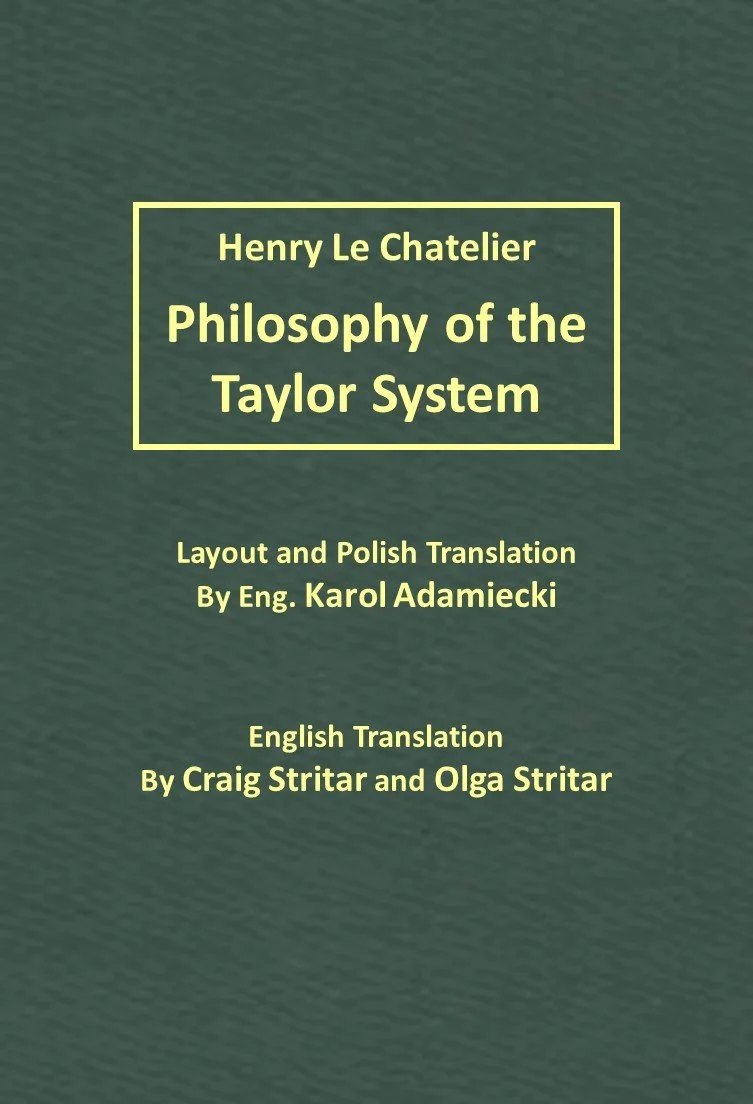
Le Chatelier entrusted the translation and arrangement of the Polish edition, on which our translation is based, to Adamiecki, who also wrote the foreword. In it he observes that even among those who have read Taylor's works there are very few who have properly understood the fundamentals, and that there is only one commentator who captured Taylor's main guiding idea better than the author himself.
The 1928 French edition
Le Taylorisme, scanned in full.
Our scan of the 1928 French language edition, in five parts. Please add it to your collection if you maintain one.
- Part I: Preface, Chapter 1 But du Taylorisme, Chapter 2 Définition du Taylorisme
- Part II: Chapter 3, L'organisation
- Part III: Chapter 4, La méthode scientifique. A. Principe de division
- Part IV: Chapter 5, La méthode scientifique. B. L'Expérimentation
- Part V: Chapters 6 to 8, teaching of organization, and conclusion
The Polish original, at the Polish Digital Science Repository
The books
Both collections in print.
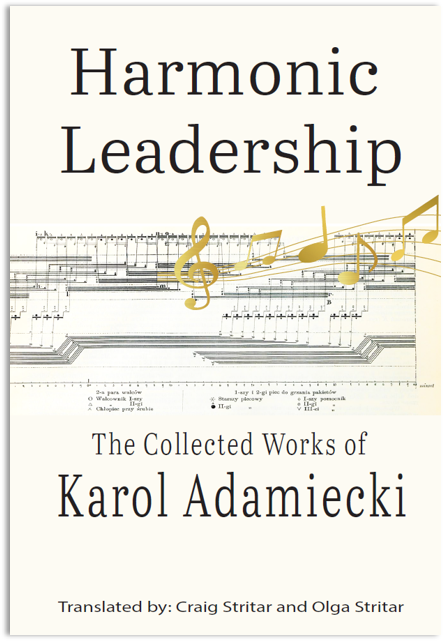
Harmonic Leadership: The Collected Works of Karol Adamiecki and Philosophy of the Taylor System by Henry Le Chatelier are both available in paperback and ebook, translated by Craig Stritar and Olga Stritar. The material above is free regardless, and always will be.
If the translations are useful to you, the most valuable thing you can do is cite them, so the next person looking for the primary sources can find them.
Curious how this would work on your team?
Book a discovery conversation. We will ask what you are trying to achieve and what is getting in the way, which is also how every engagement starts. Practical conversation, no sales pitch.