Industries / Manufacturing
Design it right and the line almost runs itself.
Most of the cost and most of the difficulty of building something is decided before anyone builds it. The cheapest time to fix a work cell is while it is still made of cardboard.
Documented, IDEX Health & Science
- Four hours to 20 minutes Assembly time on a new $20 million per year product line after a 3P design for manufacturability event. IDEX Health & Science, Rohnert Park
- Three operators to one Operators required per unit on the same line, a consequence of the redesign rather than a target set for it. IDEX Health & Science, Rohnert Park
- A planned expansion avoided Deploying the site daily management system and coaching leaders, engineers and front line teams freed enough capacity that the facility expansion was not needed. IDEX Health & Science, Rohnert Park
The 3P event
A protein analyzer, redesigned by the people who build it.
IDEX Health & Science in Rohnert Park makes precision fluidics: tubing extrusion, degassers, pumps, valves, manifolds, and the assembly and testing of components for HPLC systems.
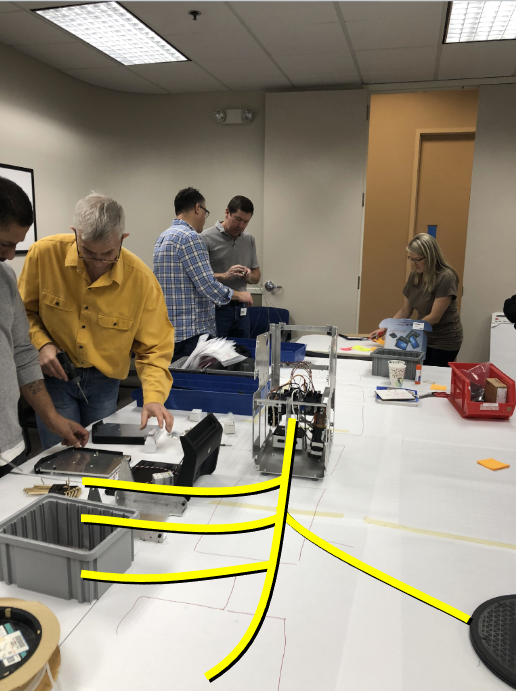
A new product line, a protein analyzer, was heading into production with a four hour assembly time. Craig assembled and led a cross-functional team of assembly line operators, manufacturing engineering, and design engineering to run a 3P design for manufacturability event on it.
The composition of that team is the whole method. Design engineers rarely watch someone assemble what they drew. Operators rarely get asked before the fixture is bought. Putting all three in a room with rough mock-ups, first principles thinking, value stream mapping and standard work surfaces in two days what a year of production would teach expensively.
Assembly came out at twenty minutes, with one operator instead of three, on a line worth $20 million a year.
The rest of the site
Three changes that outlasted the event.
A one-piece-flow model cell
Built on the most profitable product line. It removed two days of floor inventory and made a quality problem visible the moment it happened, instead of two days later when a batch reached the next station. Rework that would previously have been discovered in bulk simply stopped occurring.
New Product Introduction on one board
NPI ran through project tracking software that nobody could see at a glance. We complemented it with a simple red, yellow and green stoplight board and a standing weekly stand-up with the three engineering groups. That replaced hours of less productive meetings and gave every group the same shared picture.
A daily management system
Deployed across the site with daily coaching for leaders, engineers, and front line teams. This is the part that made the rest durable, and the reason the company was able to avoid a planned facility expansion rather than simply run a good event.
Earlier, and still relevant
Two projects from high-volume operations.
Both are from Craig's time as Pharmacy Automation and Shipping Manager at Express Scripts, running a $30 million budget and more than 50,000 prescriptions a day.
Cold chain packaging. Temperature sensitive medications, insulin among them, had been a bottleneck every warm season for nearly two decades. Breaking the packaging task down and analyzing each step for a faster, more ergonomic and cheaper method produced a proposal to use auto-bagging heat-seal bags already in use for other products. That proposal met scepticism, including from the person who had assigned the project. Proof of concept experiments led to higher fidelity confirmatory tests, then to qualifying and validating a new packaging supply chain. Throughput and ergonomics both improved, material cost fell significantly, and the bottleneck disappeared. The process was later requested by a second site on the other coast, the first time a manager had been sent between sites for that purpose.
Zip code sort automation. Detailed analysis with shipping vendors, then project leadership with corporate research and development hardware and software engineers, produced an automated zip code sorting system that saved close to $1 million a year.
Both are twenty years old. They are here because they show the pattern before any of it had a name attached: go and look, break the work down, run cheap experiments, and let the result argue for you.
What we would say in a first conversation
Do not start with the tool.
If a specific tool looks like a good solution, the more useful question is what problem drove the development of that tool, and whether you have that problem. Asked about value stream mapping, a manager at Toyota's Kamigo engine plant said it was an analysis technique not widely used there. Kamigo had different problems, so they used different tools.
What that manager said was most widely used was rigorous thinking and problem solving. That is harder to buy and worth considerably more.
None of the tools are wrong, and most are useful. Implementing them is just not the goal.
Curious how this would work on your team?
Book a discovery conversation. We will ask what you are trying to achieve and what is getting in the way, which is also how every engagement starts. Practical conversation, no sales pitch.